
When we think about cybercrime, we often imagine hackers breaking into computers, stealing passwords, or attacking online systems.
But in reality, many security incidents begin much earlier and much closer to us.
Unauthorized access does not always happen through technology. Sometimes it starts when someone gains access to information, devices, accounts, conversations, or private spaces without proper permission.
This can happen in schools, colleges, homes, public places, workplaces, community centers, libraries, hostels, cyber cafes, or even during everyday social interactions.
The surprising part is that these situations often occur not because of bad intentions, but because people are unaware of the risks.
Why Is This Dangerous?
Most unauthorized access does not immediately result in a crime. Instead, information is collected little by little.
Someone may learn your full name, mobile number, email address, daily routine, place of study or work, family details, banking habits, social media activity, personal interests, or password and PIN habits.
Individually, these details seem harmless. Together, they create a complete picture of your life.
Cybercriminals, fraudsters, impersonators, and social engineers often use this information to build trust and manipulate victims. This is how many online scams begin.
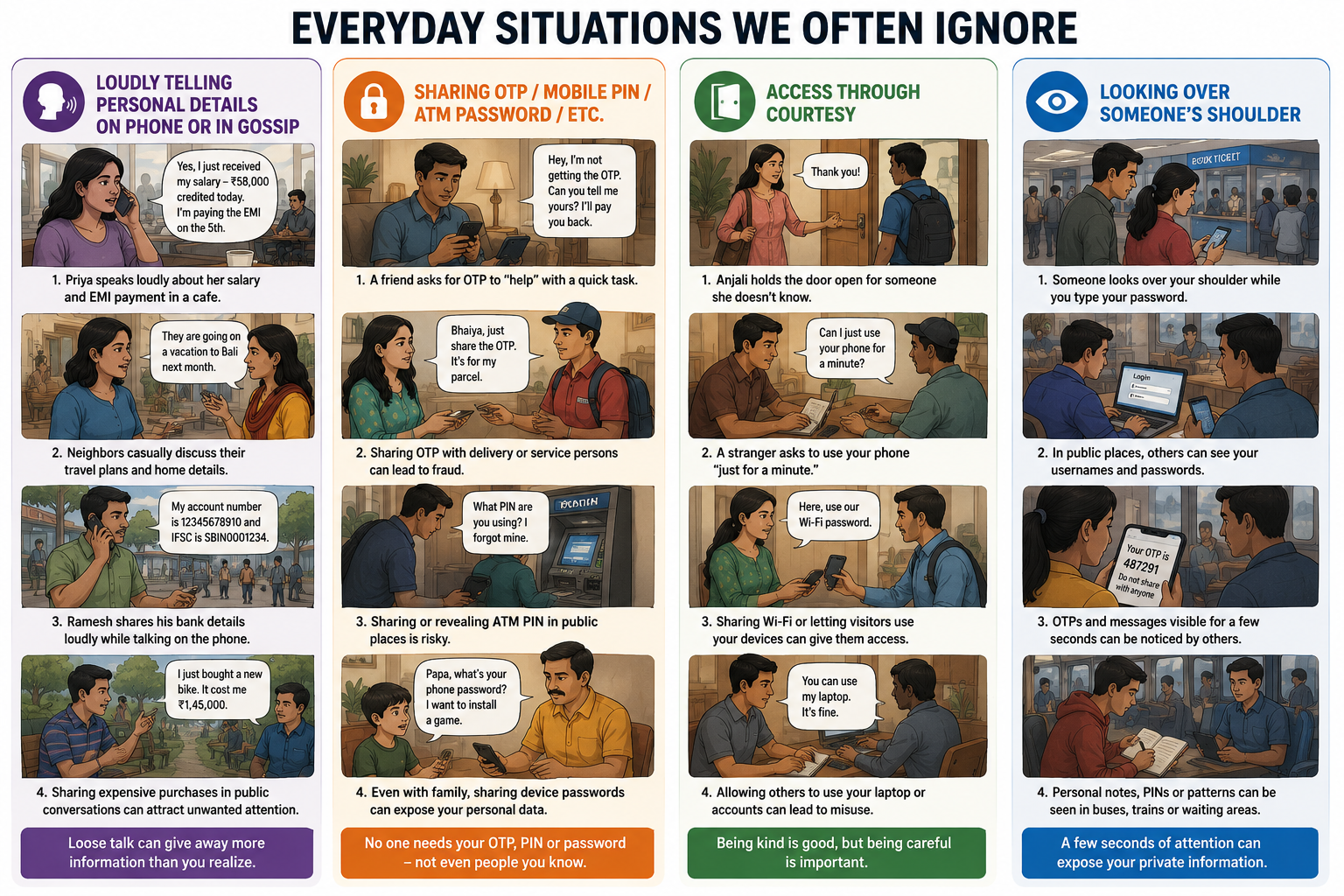
Everyday Situations We Often Ignore
- Personal details are spoken loudly in public or during casual gossip.
- OTPs, mobile PINs, ATM PINs, or passwords are shared with friends, family members, delivery persons, or service providers.
- Someone enters a restricted area because another person politely holds the door open.
- A stranger asks to use a phone, laptop, Wi-Fi connection, or account "just for a minute."
- People look over someone's shoulder while they type passwords or read private messages.
- Devices are left unlocked or handed over without thinking about what is visible.
- Personal notes, PINs, patterns, and documents are visible in buses, trains, waiting areas, or public offices.
Cyber Safety Starts with Awareness
Whether you are a student, parent, homemaker, professional, entrepreneur, retiree, or community volunteer, cybersecurity is relevant to you.
Protecting information is not only the responsibility of technology experts. It is a shared responsibility.
- Be aware of who can see your screen.
- Avoid sharing passwords, OTPs, PINs, or personal credentials.
- Lock devices when not in use.
- Verify before sharing information.
- Be cautious when someone requests access to your phone or accounts.
- Question unusual requests politely.
- Avoid discussing private financial or family details in public.
- Do not allow unknown people into restricted spaces without proper permission.
- Protect personal information both online and offline.
One Small Moment. One Big Responsibility.
Most security incidents do not begin with advanced hacking tools.
They begin with a moment of carelessness, misplaced trust, or lack of awareness.
The next time you share information, lend a device, enter a public place, or notice someone trying to access something that is not theirs, pause and think.
Cyber safety is not only about protecting computers. It is about protecting people, privacy, identity, and trust.
Bharatiya Navchetana Foundation (BNS) works to create aware, responsible, and digitally safe communities through education, prevention, and participation.